
Body weight only workouts
+ Important Guidelines for These Programs
- Follow the prescribed reps, sets, tempo and rest periods to a T. If you can complete more reps than the prescribed rep range (for example, the rep range is 8-10 and you can complete 11 or more reps), choose a more difficult progression of the exercise.
- How to read tempo: Tempo will always be displayed in 4 digits. The first number refers to the eccentric or lengthening portion of the exercise. The second number is the pause after the eccentric. The third is the concentric or lifting. The last number is the pause after the concentric.
A 4010 tempo would involve lowering for 4 seconds, no pause, lifting for 1 second and continuing again without a pause.
- Lift with intent on every movement. No bouncing around. Focus on squeezing the target muscle(s) as hard as humanly possible.
- Within the .pdf files - click the name of the exercise and you'll be redirected to a short video going over technique.
+ How to Read These Workouts
- Ex# - Denotes the exercise sequence. “A” would indicate this is the first exercise for you to perform. “B” would be the second exercise to perform. “A1” & “A2” indicates a superset – perform a set of A1 then perform a set of A2. After the appropriate rest return to A1.
- Body Part – Denotes the body part being trained for the exercise. Exercise – Denotes the exercise to be performed.
- SQ – Denotes the strength quality being trained – Relative Strength, Functional Hypertrophy, Hypertrophy, Strength Endurance, or Energy Systems.
- Sets – Denotes the number of sets to be performed
- Reps – Denotes the number of reps to be performed. Often, reps will be listed in ranges, for example, “6-8”. Let the reps chosen dictate the weight to be used. As such, with “6-8” reps, you should choose a weight that allows you to get between 6 and 8 reps. If you can get more than 8 reps, the weight is too light. If you fail to achieve 6 reps, the weight you’ve chosen is too heavy.
- Tempo – Denotes the speed the weight should be lifted. The tempo will always be Performed as outlined on the chart to the right.
- Rest – Denotes the rest period in seconds after the completed lift. It is imperative that you adhere to the specified rest period!

Workout 3: Jailhouse Lunges, Split Squats, or Bodyweight Squats
The Jailhouse Method is a descending order of repetitions. The Jailhouse 20 is a total of 210 repetitions, where set 1 is performed with 20 repetitions, set 2 is 19 repetitions, set 3 is 18 repetitions, set 4 is 17, and so on. Each set descends by one repetition. A Jailhouse 30 is a total of 465 repetitions. After each set is performed, walk 16 feet: 8 feet across your cell—or motel room, in this case—and 8 feet back. This serves as your interval rest period. The lower-body workout is designed to take 30 minutes.

Workout 4: DECK OF PAIN
Got a deck of cards? Make them work for you. The deck of pain is a way to use the slick gambler's favourite tool for more than just five card stud.
Take a 52-card deck and shuffle the cards so you have no idea what card will come up next. Flip the first card and do however many push-ups the card says. For face cards—jack, queen, and king—do 10 push-ups. When you turn up an ace, do 11 push-ups. Once completed, you will have done 380 push-ups. For the Deck of Pain neophyte, shoot to complete the deck in less than 15 minutes. Ladies can do push-ups from the knees.
Want another masochistic variation? Have each suit represent an exercise. For example: hearts = lunge; spades = push up; diamonds = bodyweight squat; clubs = an ab exercise. Get through the deck as fast as you can.

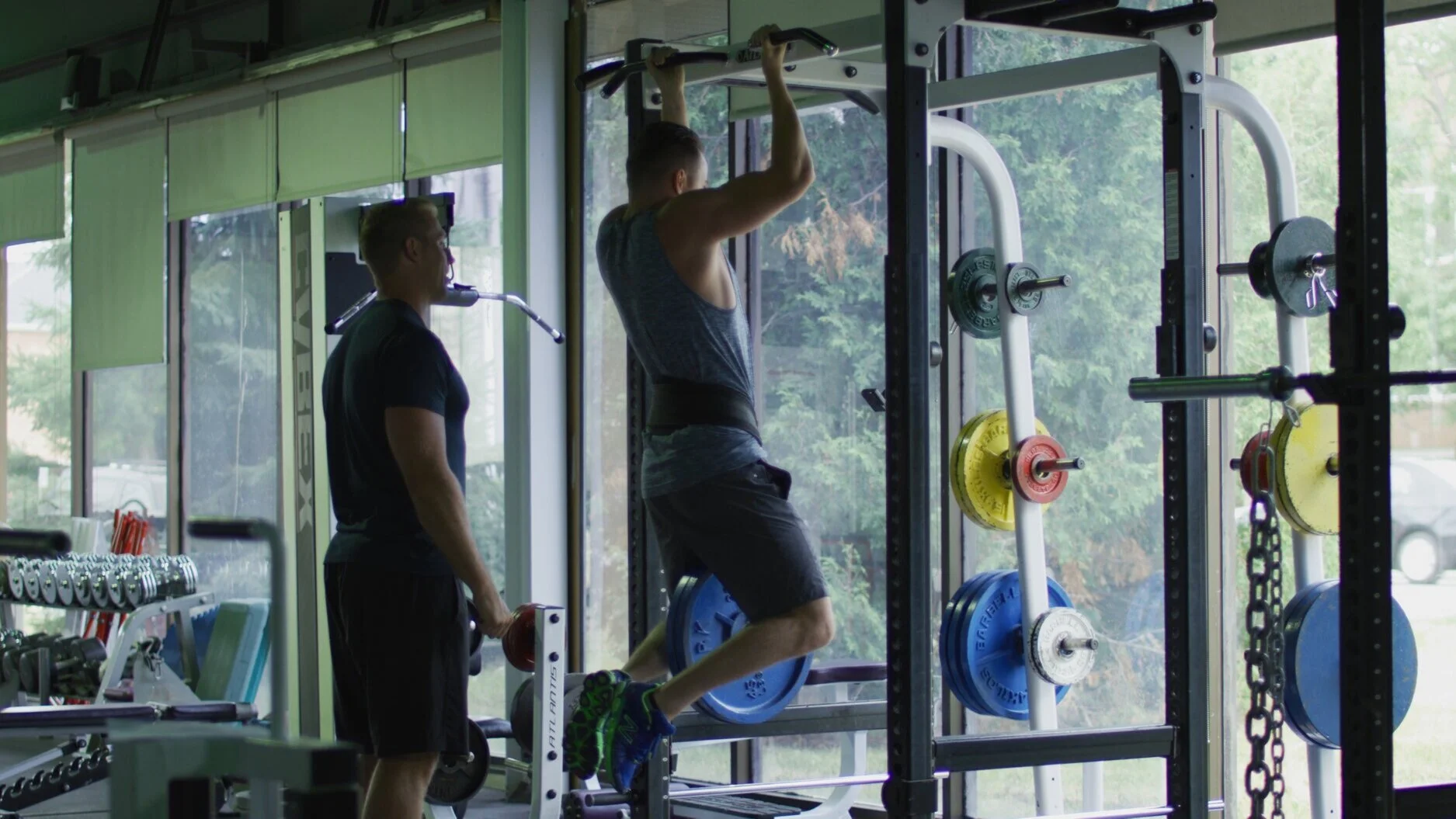
Workout 5: Have access to a chin up bar?
Try to complete 60 reps of chins in as few sets as possible. No chin up bar? Find a bannister in your garage or basement. Throw an old towel over it and use that for chin ups. You’ll improve your grip strength at the same time.

Workout 6: The “Grease the Groove” Method
Strength is the mother of all qualities. As you get stronger, you’ll be able to progress other training goals at a faster pace. This method is designed to get you stronger on a SINGLE exercise. Strength is a skill - repetition is huge towards building impressive strength.
Here’s how it works:
1. Pick an exercise you want to get stronger at. This can be done with bodyweight or a traditional exercise with weights. Push ups (both regular and from the knees for ladies), chin ups, squats, dips, deadlifts, and hand stand push ups are fair game.
2. On day 1, you are going to find your max for that exercise. It can be either a 1 Rep Max or Max number of repetitions. For example, you would do one all out set of bodyweight chin ups and record the number.
3. Let’s say you were able to 10 chin ups. You are going use 60% of that number - in this case 6 reps. Spaced randomly through out each day, you are going to aim to get 8-12 sets of 6 reps. These reps should be done explosively and with minimal fatigue. You should absolutely NOT miss a single rep or fail at any moment. This should only take you 2-3 minutes, so you can use it to break up your day.
4. After one week, you are going to re-test your max. Use that new 60% mark to keep the progress going.
This program works by giving you a lot of submaximal, high quality repetition. The key here is frequency and high quality. I have had people go from 11 chin ups to 22 chin ups using this method.

Workout 7: Glute Emphasis
Here’s one for the ladies: a bodyweight only glute workout. Expect difficulty sitting after this one! Be sure to read the notes on this one and click the name of the exercise to see a video for technique!

Workouts 8 - 12: Minimal Equipment Functional Hypertrophy
Have access to some weights at home? Consider yourself lucky. Here’s 4 workouts designed for functional hypertrophy - a mix of strength and muscle mass. These are targeted for different areas. Equipment you’ll need: a barbell, a chin up bar, a power rack, dumbbells and an adjustable bench.